
Photobucket - Video and Image Hosting
Name: The Wittenberg Door

A child of the Reformation armed with a catechism is more powerful than a Pentecostal armed with his spirit man.

Friday, November 20, 2009

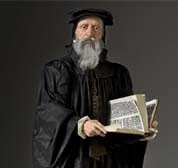
Justin Martyr: Defender of the "True Philosophy

I fell in love with the prophets and these men who had loved Christ; I reflected on all their words and found that this philosophy alone was true and profitable.

The Christian History & Biography Web site has a brief but fascinating biography of Justin Martyr. One of the most interesting parts of the article is the first-hand description of a second-century church service:

On the day called Sunday there is a gathering together in the same place of all who live in a given city or rural district. The memoirs of the apostles or the writings of the prophets are read, as long as time permits. Then when the reader ceases, the president in a discourse admonishes and urges the imitation of these good things. Next we all rise together and send up prayers.

When we cease from our prayer, bread is presented and wine and water. The president in the same manner sends up prayers and thanksgivings, according to his ability, and the people sing out their assent, saying the 'Amen.' A distribution and participation of the elements for which thanks have been given is made to each person, and to those who are not present they are sent by the deacons.

Those who have means and are willing, each according to his own choice, gives what he wills, and what is collected is deposited with the president. He provides for the orphans and widows, those who are in need on account of sickness or some other cause, those who are in bonds, strangers who are sojourning, and in a word he becomes the protector of all who are in need.

You can read the entire article here.

Oldest Church Discovered

And speaking of the early church, archaeologists believe they’ve found the site of a church dating back to between 33 to 70 AD, which would make it the oldest yet discovered:

If tests confirm that it dates back to between 33 AD to 70 AD, as the archaeologists claim, it would make it the earliest known place of Christian worship by around two hundred years.

According to a report in the Jordan Times newspaper, a very early underground church was found beneath the ancient Saint Georgeous Church, which itself dates back to 230 AD, in Rihab, northern Jordan near the Syrian border.

"We have uncovered what we believe to be the first church in the world, dating from 33 AD to 70 AD," Abdul Qader al-Husan, head of Jordan's Rihab Centre for Archaeological Studies, said.

"We have evidence to believe this church sheltered the early Christians – the 70 disciples of Jesus Christ."

A mosaic found in the church describes these Christians as "the 70 beloved by God and Divine". Mr Husan said they believed to have fled persecution in Jerusalem and founded churches in northern Jordan.

He cited historical sources which suggest they both lived and practised religious rituals in the underground church and only left it after Christianity was embraced by Roman rulers in the fourth century AD.

You can read the entire article here.

Labels: ,

Thursday, November 19, 2009

Mary, Mother of God

What is the meaning of “conceived by the Holy Ghost, born of the virgin Mary?"

That the eternal Son of God, who is and continues true and eternal God, took upon Himself the very nature of man, of the flesh and blood of the virgin Mary, by the operation of the Holy Ghost, so that He might also be the true seed of David, like unto His brethren in all things, except for sin.

The Heidelberg Catechism, Q & A 35

The Council of Ephesus (also known as the Third Ecumenical Council) met in 431 A.D. to confront a heresy called Nestorianism. The Nestorius controversy centered on the term “Mother of God.” Instead of Theotokos (Mother of God), Nestorius (c. 381–c. 451) taught that Mary was Christotokos, or “Mother of Christ.” In a nutshell, Nestorius claimed that Jesus was two persons (one human, the other divine) in one body, and that Mary only gave birth to the “human” part, not the divine.

The council declared Nestorianism heresy and affirmed the Nicene Creed (325, 381) which maintained that Christ was both human and divine and “incarnate of the Holy Spirit and the Virgin Mary . . .”

What Say Protestants

Protestants affirm the Nicene Creed and the Council of Ephesus. Consequently, we affirm the statement that Mary is the mother of God. That being said, I do have a recommendation for when you’re discussing this: clearly define what you mean when you use the term. Here’s why. Consider the following syllogism:

Mary is the mother of Jesus.
Jesus is God.
Therefore, Mary is the mother of God.

So far so good; but then . . .

Mary is the mother of God.
God is a Trinity.
Therefore, Mary is the mother of the Trinity.

You can see how this can get away from you. For this reason it’s important that you understand and clearly communicate the doctrine of the incarnation, so that it’s clear what you mean by Mary being the mother of God. I particularly favor the Athanasian Creed (c. 500) on this topic.

Named after Athanasius (293–373 A.D.), defender of the Trinity against another Christological heresy, Arianism
(great granddaddy to the Jehovah Witnesses), the creed comprises two parts: the first sets forth the doctrine of the Trinity, and the second the incarnation and dual natures of Christ. Here’s a portion:

. . . The right faith therefore is that we believe and confess that our Lord Jesus Christ, the Son of God, is God and Man. He is God of the substance of the Father begotten before the worlds, and He is man of the substance of His mother born in the world; perfect God, perfect man subsisting of a reasoning soul and human flesh; equal to the Father as touching His Godhead, inferior to the Father as touching His Manhood. Who although He be God and Man yet He is not two but one Christ; one however not by conversion of the Godhead in the flesh, but by taking of the Manhood in God; one altogether not by confusion of substance but by unity of Person. For as the reasoning soul and flesh is one man, so God and Man is one Christ . . .

Can’t Get Enough of Mary?

On a similar note, Rev. Lee Johnson at the Two-Edged Sword blog has two great posts pertaining to Mary:

  • Rejecting Mariology
    Did the early church fathers believe that Mary was sinless? Did they worship her? In this post Rev. Johnson provides the history behind Mary’s rise to veneration.

  • Roman Degradation of Mary
    Was Mary sinless? Was she perpetually a virgin? Here Rev. Johnson answers the charge that Protestants degrade Mary and shows that it’s actually Rome who’s doing the degrading by making her into something she’s not.

Labels: , , ,

Wednesday, November 18, 2009

You might be a Calvinist If . . .


Always a source of good, clean (albeit off kilter) fun, Tominthebox News Network offers the Jeff Foxworthyesque You Might be a Calvinist . . .


  • If your child’s first word was “Westminster”

  • If you send your mother tulips on Mother’s Day

  • If you’ve ever heard a wave of groans sweep through Sunday School when you refer to Romans 9

  • If you’ve ever read parts of “The Bondage of the Will” to children under ten and prayed that it would change their lives

You can read the entire list here.

Labels:

Tuesday, November 17, 2009

Notable Quote: N.T. Wright

N.T. Wright on the incarnation and John’s gospel:

[The Gospel of John] issues a sharp and timely reminder to re-learn the difference between mercy and affirmation, between a Jesus who both embodies and speaks God’s word of judgment and grace and a home-made Jesus (a Da Vinci Code Jesus, if you like) who gives us good advice about discovering who we really are. No wonder John’s gospel has been so unfashionable in many circles. There is a fashion in some quarters for speaking about a ‘theology of incarnation’ and meaning that our task is to discern what God is doing in the world and do it with him. But that is only half the truth, and the wrong half to start with.

John’s theology of the incarnation is about God’s word coming as light into darkness, as a hammer that breaks the rock into pieces, as the fresh word of judgment and mercy. You might as well say that an incarnational missiology is all about discovering what God is say No to today, and finding out how to say it with him. That was the lesson Barth and Bonhoeffer had to teach in Germany in the 1930s, and it’s all too relevant as today’s world becomes simultaneously, and as the same points, more liberal and more totalitarian … Let’s get real, let’s get Johannine, and let’s listen again to the strange words spoken by the Word made flesh.

Labels:

Monday, November 16, 2009

The Nazi at The Door – Considering Moral Dilemmas

We, as God’s people, are required to think His thoughts after Him. This is no small task. This means that we have to face tough moral and theological questions carefully and thoughtfully, all the while not surrendering the sure foundation of God’s Word. It's against this backdrop that I broach the topic of today’s post: moral dilemmas.

A note of warning: this topic carries with it a certain amount of controversy. For that reason I remind you to "Test all things; hold fast what is good" (1 Thessalonians 5:21).

Moral Dilemmas

You are on the horns of a moral dilemma if you are caught between competing moral requirements. Here is the most common modern example:

It is wartime Germany and you are hiding Jews in your basement. There’s a knock at the door—Gestapo performing a house-by-house search! They ask if you are hiding Jews in your basement. You pause as you consider your answer.

  • “If I say ‘yes,’ they will kill them"

  • “If I say ‘no,’ then I’m lying"

Dilemma: The only way to protect the innocent is to lie.

No Win Situation?

Some characterize this as “choosing between two evils.” But this characterization is false. God will never put us in a situation where we can’t please Him, where we must sin.

No temptation has overtaken you but such as is common to man; and God is faithful, who will not allow you to be tempted beyond what you are able, but with the temptation will provide the way of escape also, so that you will be able to endure it.

1 Corinthians 10:13

15) For we do not have a high priest who cannot sympathize with our weaknesses, but One who has been tempted in all things as we are, yet without sin.

16) Therefore let us draw near with confidence to the throne of grace, so that we may receive mercy and find grace to help in time of need

Hebrews 4:15-16

Although Christ was not specifically tempted with Nazis at the door, He did face every kind of temptation. Each temptation met its defeat. Based on Christ’s triumph, and the Corinthian passage, we can conclude that any particular instants of sin can be overcome by the believer. Since sin can always be resisted, we’ll never face a “no win situation” morally.

This is true, but this savors of a carnal heart to think that you must choose one sin rather than another. You must not choose any of them! Both of them are evil, though one may be less evil than another.

Jeremiah Burroughs (1599–1646)

Scriptural Considerations

The Ninth Commandment forbids lying (Ex. 20:16). But are we to take from this passage that all lying is forbidden? To answer that question we must first remember that the Ten Commandments are but a summary of God’s Law. To be faithful, we must take into account all of what God's Word says.

1) Now the LORD said to Samuel, "How long will you grieve over Saul, since I have rejected him from being king over Israel? Fill your horn with oil and go; I will send you to Jesse the Bethlehemite, for I have selected a king for Myself among his sons."

2) But Samuel said, "How can I go? When Saul hears of it, he will kill me." And the LORD said, "Take a heifer with you and say, 'I have come to sacrifice to the LORD.'

1 Samual 16:1–2

Here we see the Lord instructing Samuel to deceive Saul. If Samuel would have told Saul the truth, Saul would have killed both him and David. Through the lie, both men where spared and God’s plan of redemption continued.

Also consider 1 Kings 22. Prior to going to war against Syria, king Ahab consults his 400 brown-nosing prophets who basically say “you da’ man, boss!” (that’s my own translation). Unsatisfied, the king summons Micaiah. Micaiah (eventually) tells the king of his pending doom, and a bit more:

19) Micaiah said, "Therefore, hear the word of the LORD. I saw the LORD sitting on His throne, and all the host of heaven standing by Him on His right and on His left.

20) "The LORD said, 'Who will entice Ahab to go up and fall at Ramoth-gilead?' And one said this while another said that.

21) "Then a spirit came forward and stood before the LORD and said, 'I will entice him.'

22) "The LORD said to him, 'How?' And he said, 'I will go out and be a deceiving spirit in the mouth of all his prophets.' Then He said, 'You are to entice him and also prevail. Go and do so.'

1 Kings 22:19–22

Thus God mislead Ahab into battle.

And how about Rahab? We read in Joshua 2 that she lied to protect the spies. Do the Scriptures condemn her? No. Actually, because of her deception, she was included in the “Faith Hall of Fame” (Hebrews 11:31).

Conclusion: “There are No Jews Here”

The “Nazi at the door” is not a true moral dilemma—we are not actually caught between competing moral choices. As a matter of fact, God will never put us in a situation where we truly have to choose between two of His commands.

God does expect us, however, to make moral choices that are consistent with His revealed will. This means that we cannot simply stop at the summary of God’s law, but, instead, we must press on to consider the totality of what God has to say.

In our short study, we found that truth-telling is the general rule. But in certain situations (such as when protecting innocent people, or during a time of war) God allows for deception. That being said, there is something very important we must remember: Because God’s character is the standard of morality, He is the only One able to determine when deception is allowed—not us. Therefore, study the Scriptures carefully, for God takes His commands seriously.

Labels: ,

Sunday, November 15, 2009

Notable Quote: R.C. Sproul

R.C Sproul on the three purposes of the law:

The first purpose of the law is to be a mirror. On the one hand, the law of God reflects and mirrors the perfect righteousness of God. The law tells us much more about who God is. Perhaps more important, the illumines human sinfulness.

A second purpose for the law is the restraint of evil. The law, in and of itself, cannot change human hearts. It can, however, serve to protect the righteous from the unjust … The law allows for a limited measure of justice on this earth, until the last judgment is realized.

The third purpose of the is to reveal what is please to God. As born-again children of God, the law enlightens us as to what is pleasing to our Father, whom we seek to serve … This is the highest function of the law, to serve as an instrument for the people of God to give Him honor and Glory.

Labels:

Saturday, November 14, 2009

Deck Thyself, My Soul, With Gladness

Deck thyself, my soul, with gladness,
Leave the gloomy haunts of sadness,
Come into the daylight's splendor,
There with joy thy praises render
Unto him whose grace unbounded
Hath this wondrous banquet founded;
High o'er all the heavens he reigneth,
Yet to dwell with thee he deigneth.

Jesus, Bread of life, I pray thee,
Let me gladly here obey thee;
Never to my hurt invited,
Be thy love with love requited;
From this banquet let me measure,
Lord, how vast and deep its treasure;
Through the gifts thou here dost give me,
As thy guest in heaven receive me.

Johann Franck (1618 – 1677)

Labels:

Friday, November 13, 2009

Unique? It Really Is!

From Great Commission Publications:

Many authors have been captured by a noble theme; we call them inspired. Many books have stirred hearts and even changed lives; we call them inspiring. Paul speaks of Scripture in a completely different sense. Whatever power exists in the written word to move the soul or redirect a life—and that power is considerable—it is different from that of the Bible. “All Scripture is breathed out by God and profitable for teaching, for reproof, for correction, and for training in righteousness, that the man of God may be competent, equipped for every good work” (2 Tim. 3:16:17).

First, look at the Bible’s source. It is breathed out, as it were, by God himself. God’s agency is direct and intimate, not merely providential. God’s agency is direct and intimate, not merely providential. God did more than guide the authors of Scripture in producing the final result. The human authors varied in their literary skills, education, and background, note of which God bypassed in using them. But, as Peter notes, “no prophecy was ever produced by the will of man, but men spoke from God as they were carried along by the Holy Spirit” (2 Pet. 1:21). As B. B. Warfield wrote, “The men who spoke from God are here declared, therefore, to have been taken up by the Holy Spirit and brought by His power to the goal of his choosing.” It was not their goal or their agenda they were promoting, but God’s. Whatever the Bible says, God says. And therefore, to quote Warfield again, the writers of Scripture looked on their work as “divinely safeguarded in even its verbal expression, and as divinely trustworthy in all its parts, in all its elements, and in all its affirmations of whatever kind.”

The Bible’s source is the key to its power. Because it is God-breathed, the Bible is therefore “profitable for teaching, for reproof, for correction, and for training in righteousness.” Scripture does what no merely human writing can do. It reveals the totality of God’s will concerning everything we need to know on earth about the righteousness that God demands. And in doing that, it is the perfect instrument for equipping the Christian minister completely for his work—and the Christian layperson too.

The questions for you today are these: What are you doing with God’s word? Are you in it daily, even if briefly? Are you letting the Word “dwell in you richly”? (Col. 3:16). If it is God’s Word, dare we treat it as optional reading?

May God give us perseverance in his Word.

Labels:

Thursday, November 12, 2009

Today in Church History: Adopting Act (OPC, 1936), General Assembly (2nd: 1936)

On Thursday, November 12, 1936, the Second General Assembly of the Presbyterian Church of America (later to become the Orthodox Presbyterian Church) convened in Philadelphia, Pennsylvania.

As commissioners met for three days in the Manufacturers' and Bankers' Club on Walnut and Broad Streets, the main item on their agenda was the report from the Committee on the Constitution on the adoption of the Westminster Confession of Faith and Catechisms as the doctrinal standards of the five-month-old church. The debate centered on whether or not the church should include the 1903 confessional revisions in its version of the standards. While it was generally agreed that those revisions were Arminian and anti-Reformed, some commissioners argued that the inclusion of those revisions would bolster the church's claim of being the "spiritual successor" to the Presbyterian Church in the USA, and thus help congregations in their legal battle to maintain their property. Cornelius Van Til spoke in opposition to such expediency: "Shall we be Arminians before the courts this year, with the full expectation of being Calvinists next year?"

The Presbyterian Guardian described the outcome of the debate in this way: "When the vote was taken by roll-call on this all-important matter the result was the adoption of the Westminster Confession of Faith and Catechisms, without the obnoxious 1903 revisions, by the decisive majority of 57 to 20."

-John Muether

Labels:

Wednesday, November 11, 2009

Jacob’s Ladder

In Genesis 28 we find God speaking to Jacob in a dream. The Lord tells Jacob that his descendants will multiply, be blessed of God, and will inherit the land upon which he was laying (vrs. 13 and 14). The Lord also promised to be with Jacob wherever he goes and to bring him back to this land (vrs. 15). Prior to the Lord’s address, however, a strange vision was given to Jacob.

He had a dream, and behold, a ladder was set on the earth with its top reaching to heaven; and behold, the angels of God were ascending and descending on it.

Genesis 28:12

No explanation of the vision is provided in the text. So what does it mean?

Ziggurats

During Jacob’s journeys through ancient Mesopotamia, it is certain that he saw many ziggurats. These temple towers, which appear not only in the Middle East but also in Central America, were a place of sacrifice to various gods. The most famous ziggurat being the Tower of Babel described in Genesis 11.

Ziggurats featured a stepped construction comprising a large base that ascended, step-by-step, to a much smaller summit. Upon the summit was the alter. The purpose behind the ziggurats was for men to ascend to heaven.

So What’s Jacob’s Ladder About?

For the interpretation of Jacob’s dream we must turn to the New Testament, to the words of the Savior.

And He said to him, "Truly, truly, I say to you, you will see the heavens opened and the angels of God ascending and descending on the Son of Man."

John 1:51

Christ is the ladder Jacob saw in the vision. Unlike the ziggurats where men are ascending to God, God descended to man in the person of Christ. This is the difference between Christianity and the religions of men: all non-Christian religions are works-based—man trying to ascend to God via his own righteousness. This is like a drowning man trying to climb out of a pool using a ladder of water; it can’t be done. Christianity is completely opposite: man’s works play no part in bringing the sinner to God.

Here’s the gospel in a word: imputation. It’s Christ’s righteousness (His perfect keeping of the Law) being imputed (transferred) to His people, and their sins being imputed to Him (which He bore on the cross). Men can only stand before God when clothed in Christ’s righteousness—and this was accomplished by God descending to man, not man ascending to God.

It may be demaunded, what is that thing in Christ, by and for which, we are justified. I answer, the Obedience of Christ, Rom. 5. 19. And it stands in two things, his Passion in life and death, and his Fulfilling of the law joined therewith. . . . The obedience of his passion stands before God as a satisfaction for the breach of the law. . . . By the second Obedience in fulfilling the lawe, the sonne of God performed for us, all things contained therein, that we might have right to life everlasting, and that according to the tenour of the lawe, Levit. 18.5.

William Perkins (1558-1602)

For further reading: Heidelberg Catechism, questions and answers 12–18.

Labels: ,